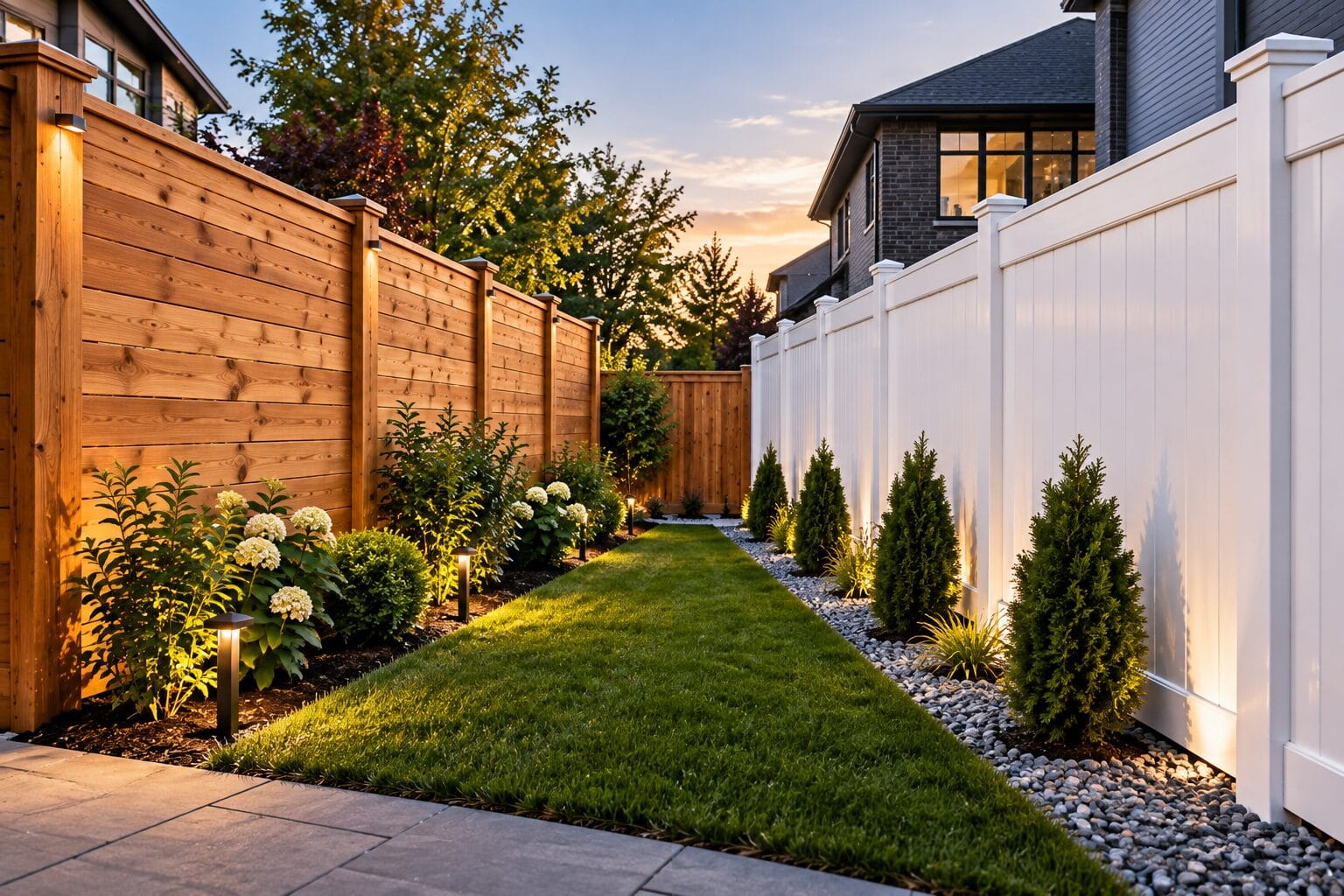
Executive Summary: In the Greater Toronto Area (GTA), vinyl privacy fencing provides a 20 to 30+ year lifespan with zero maintenance at $75 to $120 per linear foot installed, while custom Western Red Cedar offers a 15 to 25 year lifespan at $65 to $110 per linear foot but requires UV sealing every 3 years. Standard pressure-treated wood is the budget entry point at $45 to $70 per linear foot. Both material types must strictly comply with Toronto’s Chapter 447 Fence Bylaw, limiting rear-yard fence heights to 2.0 metres (6 ft 7 in) and requiring post footings dug below the 1.2-metre (4-foot) Ontario frost line.
Quick Comparison: Custom Wood vs. Vinyl Privacy Fencing
| Factor | Custom Wood (Cedar or PT) | Vinyl (PVC) |
| Upfront Cost (GTA Installed) | PT: $45–$70/lf Cedar: $65–$110/lf | Vinyl: $75–$120/lf |
| Expected Lifespan | 15 to 25 years (Cedar with upkeep) | 20 to 30+ years |
| Maintenance & Costs | Clean & re-stain every 3 years ($3–$6/lf); PT can warp/check | Wash occasionally with soap and water; $0 painting or staining |
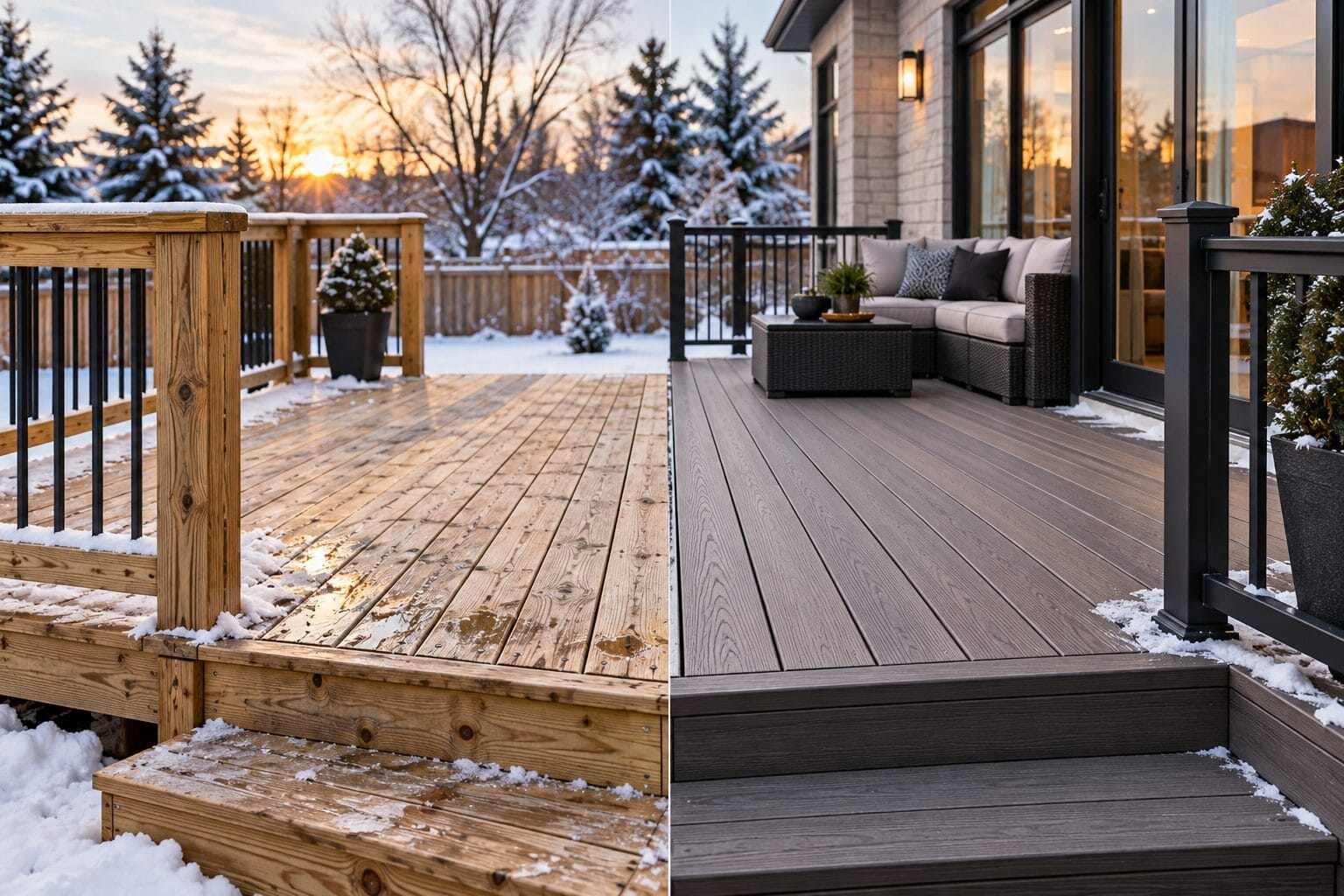
| Winter Durability | Handles freeze-thaw well when set in deep footings; wood naturally breathes | Stable, but low-grade panels become brittle in sub-zero temps; requires heavy-duty vinyl |
| Noise Reduction | Excellent; dense solid cedar or board-on-board absorbs ambient street noise | Good; hollow panels reflect sound rather than absorb it |
| Bylaw Limit (Toronto) | Max 2.0 m (6ft 7in) rear-yard height limit | Max 2.0 m (6ft 7in) rear-yard height limit |
| Customization & Repairs | High; horizontal slats, integrated lighting; easy to swap single boards | Fixed manufacturer profiles; replacing individual damaged panels can be tricky |
The Case for Custom Wood Privacy Fences
For high-end residential properties, custom wood is still the most popular choice, and for good reason:
- Design freedom: Horizontal cedar slats, staggered boards, board-on-board privacy and integrated planters or lighting can all be built to suit your home’s architecture.
- Natural insulation from noise: Solid wood panels, especially board-on-board, help absorb and block sound.
- Easy customization and repair: You can adjust height, add a gate or replace a single damaged board.
- Species options: Western red cedar is prized for natural rot and insect resistance and its rich colour. Pressure-treated pine offers a lower-cost alternative.
- A warm look for heritage neighbourhoods: Wood suits older Toronto streets and character homes.
The trade-off is upkeep: Cedar lasts 15 to 25 years only if treated with a quality UV-protective sealant every 3 years ($300–$600 per application for average yards). Left untreated, cedar weather-grays and loses structural density over time.
The Case for Vinyl Privacy Panels
- Low maintenance: Vinyl does not rot, need painting, or attract insects, and washing usually restores its appearance.
- Consistent, clean appearance: Panels stay uniform in colour and finish.
- Long lifespan: Quality vinyl can last 20 to 30+ years without staining or sealing.
- Good for busy homeowners: If you never want to think about your fence again, vinyl is attractive.
The trade-offs: Fewer design options, a manufactured aesthetic, and potential cold-weather brittleness. Cheap, thin-walled vinyl can shatter under impact in -15°C GTA winters. High-end, commercial-grade vinyl (minimum 0.135-inch wall thickness) with steel-reinforced bottom rails is mandatory for Canadian climates.
Winter Durability: What Actually Happens in the GTA
Frost heave is the biggest winter threat to any fence in Southern Ontario. When moisture-saturated soil freezes and expands, it exerts thousands of pounds of upward pressure on post footings, causing unanchored posts to tilt or heave out of the ground.
- 4-Foot Frost Line Footings: Posts must be set below the 1.2-metre (4-foot) Ontario frost line using bell-bottom concrete footings or heavy-duty steel helical piles.
- Drainage Gravel: Pour 6 inches of crushed gravel beneath concrete footings to allow ground moisture to drain away from the post base.
- Hardware Specs: Use hot-dipped galvanized or 304 stainless steel fasteners to eliminate rust bleeding during spring rains.
- Clearance Above Grade: Maintain a minimum 2-inch clearance between bottom fence boards/panels and the soil to prevent standing snow/ice contact.
Toronto Bylaws and Property Line Basics
Before installing a privacy fence, check the strict rules defined under Toronto Municipal Code Chapter 447:
- Height Limits: The City of Toronto caps rear-yard and side-yard privacy fences at 2.0 metres (6 ft 7 in) measured from grade. Front-yard fences are restricted to 1.2 metres (4 ft).
- Sight Triangles: On corner lots, fence heights within 6 metres of a street intersection are restricted to 0.75 metres (2 ft 6 in) to ensure line-of-sight safety for traffic.
- Pool Enclosures: Fences enclosing swimming pools must be at least 1.2 metres (4 ft) high with non-climbable vertical clearance and self-closing, self-latching gates.
- Line Fences Act: Boundary fences shared with neighbors are subject to Ontario’s Line Fences Act. Discuss design and cost-sharing agreements in writing prior to digging.
- Utility Locates: Ontario One Call locates must be completed prior to drilling or digging any post holes.
Cost: What to Expect in the GTA
Fence pricing across Toronto and the GTA is calculated per linear foot based on height (standard 6ft), ground conditions, excavation requirements, and materials:
| Material Type | Material & Install Cost (Per Linear Foot) | 100 Linear Foot Project Total | Maintenance Cost Over 20 Years |
| Pressure-Treated Wood | $45 – $70 / lf | $4,500 – $7,000 | $2,000 – $3,500 (staining/repairs) |
| Custom Western Red Cedar | $65 – $110 / lf | $6,500 – $11,000 | $2,500 – $4,000 (bi-annual sealing) |
| Commercial-Grade Vinyl | $75 – $120 / lf | $7,500 – $12,000 | $0 (soap and water cleaning) |
Which Should You Choose?
Choose custom wood if you…
- Want a unique, architecturally matched design (e.g., horizontal slats, board-on-board).
- Live in a heritage or character neighbourhood like Cabbagetown, The Annex, or High Park.
- Do not mind scheduling UV sealing maintenance every 3 years.
- Want the option to stain or change fence colors in the future.
Choose vinyl if you…
- Want absolute zero-maintenance privacy with $0 lifetime upkeep costs.
- Prefer a clean, uniform, modern aesthetic that matches white PVC trim.
- Want maximum privacy panels that will not warp, shrink, or crack over 25+ years.
- Plan to stay in your current home long-term.
| Pro Tip: Consider a hybrid approach—build a heavy-duty structural frame with steel posts or pressure-treated structure, combined with custom horizontal cedar panels or composite privacy boards for a modern look that handles GTA winters better than standard posts. |
How to Hire Custom Fence Builders in the GTA
When hiring custom fence builders in the GTA, evaluate these critical operational qualifications:
- Post Depth Verification: Ensure the contract explicitly specifies digging post holes to 48 inches (1.2m).
- Licensing & Insurance: Require a minimum of $2,000,000 Commercial General Liability Insurance and a valid WSIB clearance certificate.
- Utility Locates & Permits: The contractor must manage free Ontario One Call utility locates before bringing augers on site.
- Transparent Itemized Estimates: Quotes should separate post footings, lumber/vinyl grades, gates, hardware, and old fence haul-away fees.
Frequently Asked Questions
Is a wood or vinyl fence better for privacy?
Both provide 100% full privacy when built with tongue-and-groove vinyl or overlapping board-on-board wood designs. Custom wood provides better sound absorption against traffic noise due to its material density, while vinyl offers a permanent gap-free seal that never shrinks or warps over time.
How long does a cedar privacy fence last?
A custom Western Red Cedar fence in Toronto lasts 15 to 25 years, provided it is treated with a UV-protective sealant every 3 years, mounted on posts dug below the 4-foot frost line, and elevated 2 inches above ground level.
Does vinyl fencing crack in cold weather?
Cheap, thin vinyl can become brittle and crack during severe sub-zero Toronto winters (-15°C to -20°C). High-quality, commercial-grade vinyl (with thick PVC walls and impact modifiers) withstands extreme Canadian freeze-thaw cycles without cracking.
Do I need a permit for a fence in Toronto?
Standard residential privacy fences do not require a building permit as long as they adhere to the Toronto Chapter 447 Fence Bylaw (maximum height of 2.0 metres / 6ft 7in for rear yards). Swimming pool enclosures, however, require dedicated municipal permits and safety inspections before installation.
Can I install a fence in winter?
Yes. GTA fence builders execute winter fence installations by utilizing hydraulic post-hole augers or driving steel helical piles into frozen ground below the frost line, avoiding wet concrete curing issues in sub-zero temperatures.
Build a Boundary You Will Love for Decades
Whether you want a custom cedar fence or a low-maintenance vinyl privacy system, Jacko Contracting designs and installs fences, privacy panels, railings, and retaining walls built for GTA winters and local bylaws.
| Jacko Contracting Contact & Service Details Call 24/7 for a Free Estimate: 647-642-4664 Request a Free Quote: jackocontracting.com/contact-us Email: info@jackocontracting.com Office Hours (EST): Mon to Sat, 8:00 AM – 6:00 PM Service Area: Toronto, North York, Scarborough, Etobicoke, Mississauga, Brampton, Vaughan, Richmond Hill, Markham, Oakville, Milton, Pickering, and Whitby |
Why Homeowners Choose Jacko Contracting
- 15+ Years Experience: Custom fence and boundary construction across the GTA.
- Full Compliance: WSIB clearance and $2M liability insurance.
- 5-Year Workmanship Warranty: Guaranteed post depth and structural integrity against frost heaving.
- Turnkey Backyard Solutions: Decks, fences, and retaining walls built under one contract for cohesive design.
Related Services: Privacy Panels | Fence Installation | Railings Installation | Retaining Walls | Backyard Decks