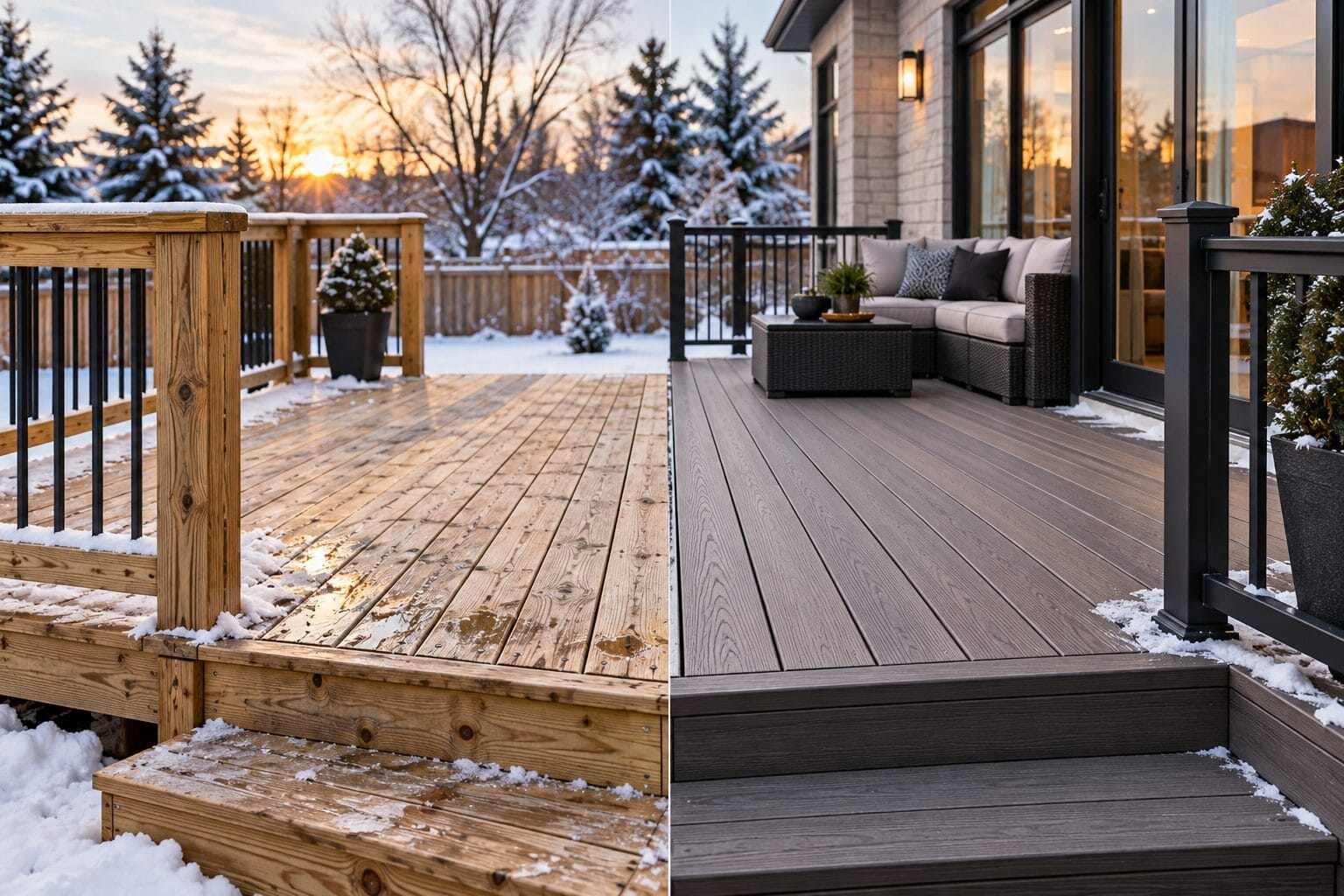
Executive Summary
In the Greater Toronto Area (GTA), pressure-treated wood decks cost $35 to $60 per sq. ft. installed ($8,000–$12,000 for a standard 200 sq. ft. deck) and last 10 to 15 years with mandatory bi-annual staining. High-performance capped composite decking costs $65 to $110+ per sq. ft. installed ($14,000–$22,000 for 200 sq. ft.), representing a 1.5x to 2.5x higher upfront investment. However, composite yields zero annual maintenance costs, a 25 to 30+ year lifespan, and immunity to freeze-thaw rot, making it the lower total-cost investment over a 20-year period in Toronto’s harsh climate.
Quick Comparison: Composite vs. Pressure-Treated Wood
| Factor | Pressure-Treated Wood | Composite Decking |
| Upfront Cost (GTA, Installed) | $35 – $60 / sq. ft. ($8,000–$12,000 for 200 sq. ft.) | $65 – $110+ / sq. ft. ($14,000–$22,000 for 200 sq. ft.) |
| Expected Lifespan | 10 to 15 years (requires constant upkeep) | 25 to 30+ years (backed by 25–50 yr warranties) |
| Maintenance | Annual cleaning; re-stain/seal every 1 to 2 years ($300–$500/yr) | Occasional soap-and-water wash; $0 staining/sealing |
| Freeze-Thaw Performance | Cracks, warps, cups, splinters, and holds surface moisture | Resists rot and splinters; expands/contracts linearly without moisture absorption |
| Snow & Ice Traction | Decent natural traction, but wood fibers degrade under ice | Capped boards with deep grain texturing perform well; requires rubber/plastic shovels |
| Aesthetic & Finish | Natural wood; can be stained or painted any custom color | Premium wood-look finishes, modern colors; fade- and UV-resistant |
| Resale Value & Appeal | Standard appeal; buyers view it as a future maintenance item | High ROI; heavily marketed as low-maintenance, turnkey outdoor living |
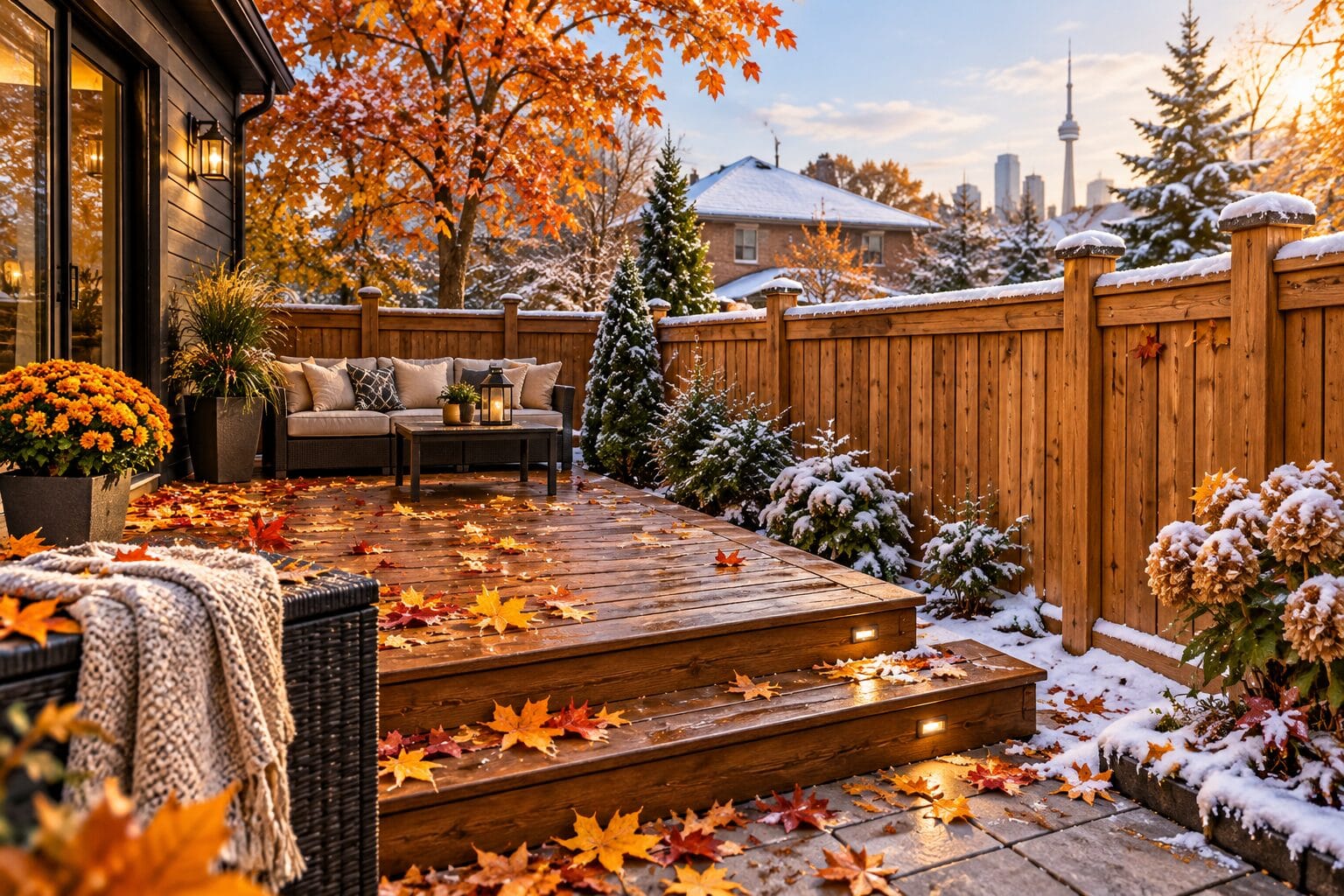
Winter Durability in Toronto and the GTA
Pressure-Treated Wood in Freeze-Thaw Cycles
Pressure-treated lumber is treated to resist rot and insects, but it remains porous wood. It absorbs melted snow and ambient moisture. When temperatures drop below freezing, trapped water expands inside the wood cells, causing checking, severe warping, cupping, splintering, and fastener loosening. Continuous sealing or staining slows down water ingress but cannot stop sub-zero freeze-thaw mechanical stress.
Composite Decking in Freeze-Thaw Cycles
Composite boards—engineered from recycled plastic polymers and dense wood fibers—absorb virtually zero moisture (typically less than 1%). Capped composite features an impenetrable polymer shield that protects against moisture, mold, and ice wedging. While composite does expand and contract with severe temperature shifts, it does so predictably along its axis. Proper gapping and temperature-calibrated fastener spacing during winter installations are critical to prevent buckling.
Snow Removal and De-icing Best Practices
- Use plastic or rubber-edged shovels: Metal blades will gouge composite board capping and splinter wood grains.
- Avoid calcium chloride or harsh rock salts: Use eco-friendly, deck-safe ice melts (such as magnesium chloride or plain coarse sand for traction).
- Clear slush and ice promptly: Prevents surface ice sheets from forming on high-traffic steps.
- Select anti-slip textured capping: When choosing composite lines, look for embossed grain patterns rated for high wet traction.
Cost: Upfront vs. Long-Term Value
Pressure-treated wood wins on upfront cost. Composite wins on lifetime cost over a 15-to-20-year horizon. Prices vary with design complexity, elevation, railings, stairs, footings, and site access.
| 20-Year Cost Breakdown | Pressure-Treated Wood (200 sq. ft.) | Composite Decking (200 sq. ft.) |
| Initial Build & Materials | $8,000 – $12,000 | $14,000 – $22,000 |
| Staining & Sealing (Every 2 Years) | $3,000 – $5,000 (DIY/Contractor over 20 yrs) | $0 |
| Board Repairs & Fastener Resets | $1,000 – $2,500 (replacement of rotted boards) | $0 (covered by manufacturer warranty) |
| Required Replacement at Year 15 | $10,000 – $15,000+ (if full rebuild needed) | $0 (decking survives 25–30+ years) |
| Total 20-Year Estimated Outlay | $22,000 – $29,500+ | $14,000 – $22,000 |
Over 15 to 20 years, the cost gap completely flips. Once you calculate repetitive staining labor, material replacements, and early structural rebuilds, pressure-treated wood becomes the more expensive option over time.
Structure, Footings, and Permits: The Part Most Homeowners Overlook
Whichever material you choose, the sub-frame underneath determines whether the deck survives a Toronto winter:
- Frost Line Depth: Footings in the GTA must extend below Ontario’s 1.2-metre (4-foot) frost line to prevent severe frost heaving during ground freezing. Helical piles or poured concrete sonotubes must be inspected prior to pouring.
- City of Toronto Permits: Under Ontario Building Code (OBC), any deck attached to a house, exceeding 60 cm (24 inches) above grade, or exceeding 10 sq. metres (108 sq. ft.) legally requires a City of Toronto building permit and structural drawings.
- Zoning & Setbacks: Rear-yard setback restrictions, lot-coverage maximums, and soft-surface landscaping minimums must be verified with local municipal zoning bylaws.
- Framing & Ledger Flashing: Pressure-treated lumber framing is standard under both wood and composite surfaces. Proper joist tape, joist spacing (12” to 16” on-center for composite), ledger board Z-flashing, and drainage gaps are vital to prevent hidden rot.
- Utility Locates: Licensed deck builders must coordinate free Ontario One Call utility locates before any excavation or pile driving begins.
Which Should You Choose?
Choose pressure-treated wood if:
- You have a strict upfront budget under $10,000.
- You prefer natural timber and do not mind dedicated weekend staining maintenance every 1 to 2 years.
- You plan to sell or move within the next 3 to 5 years and want maximum short-term cash flow efficiency.
Choose composite decking if:
- You want a low-maintenance outdoor living space with zero annual staining, sanding, or painting.
- You want a splinter-free surface safe for barefoot children and pets.
- You are building a complex or multi-level space (pool decks, outdoor kitchens, integrated lighting).
- You plan to remain in your home for 7+ years and want to maximize long-term return on investment.
| Pro Tip: Hybrid construction is the industry standard. Build the structural frame using pressure-treated lumber, then surface the deck and railings with low-maintenance capped composite. |
How to Choose Deck Builders in the GTA
The best deck builders GTA homeowners can hire will guide you through structural trade-offs, local bylaws, and manufacturer installation specs. Look for:
- Proven Wood & Composite Expertise: Experience with brand-specific installation guidelines (Trex, TimberTech, Fiberon) and proper thermal Expansion/Contraction spacing rules.
- Permit & Engineering Support: Capability to produce stamped architectural drawings, manage City of Toronto permit applications, and execute frost-line compliant footings.
- Comprehensive Coverage: Active WSIB clearance certificates and minimum $2,000,000 commercial general liability insurance.
- Workmanship Warranties: A minimum 5-year written warranty on structural installation alongside manufacturer material warranties.
- Itemized Transparent Quotes: Detailed estimates separating labor, framing materials, decking brand tiers, railings, permits, and excavation/removal costs.
Frequently Asked Questions
Q: Is composite decking good in Canadian winters?
Yes, high-grade capped composite decking handles Canadian winters exceptionally well. Because capped composite boards absorb virtually zero water, they eliminate internal freeze-thaw splitting, checking, and rot. Ensure your builder follows cold-weather installation specs for thermal movement gapping.
Q: Does composite decking get slippery in winter?
Any deck surface can become slick when covered in freezing rain or compacted snow. Capped composite boards with deep, embossed wood-grain patterns provide strong traction. To manage ice, clear snow with a plastic shovel and apply calcium-chloride-free, deck-safe ice melts or sand.
Q: How long does a pressure-treated deck last in Toronto?
A pressure-treated deck in Toronto lasts 10 to 15 years, provided it is stained and sealed every 1 to 2 years and footings are dug below the 4-foot (1.2m) Ontario frost line. Unmaintained decks exposed to GTA winter freeze-thaw cycles typically deteriorate within 7 to 10 years.
Q: Can I install a deck in winter?
Yes, winter deck installations are common in the GTA. Footings can be installed using helical steel piles driven below the frost line without pouring wet concrete. During winter composite installation, builders must maintain a minimum 1/4-inch gap at board ends to allow for thermal expansion when summer temperatures rise.
Q: Is composite decking worth the extra cost?
For most GTA homeowners, yes. While composite costs 1.5x to 2.5x more upfront, you eliminate the $300 to $500 annual cost of staining, sealing, and board repairs. Over 15 to 20 years, composite is typically cheaper than building and maintaining a wood deck.
Get a Deck Built for GTA Winters
Whether you are leaning toward pressure-treated wood or premium capped composite, Jacko Contracting helps you evaluate materials, local permit requirements, and structural designs tailored to your property. We design and build backyard decks, rooftop decks, and pool decks across the GTA—engineered with footings built specifically for freeze-thaw stability.
| CONTACT JACKO CONTRACTING FOR A FREE ESTIMATE Call 24/7: 647-642-4664 Request a Free Quote: jackocontracting.com/contact-us Email: info@jackocontracting.com Office Hours (EST): Mon to Sat, 8:00 AM – 6:00 PM Service Area: Toronto, North York, Scarborough, Etobicoke, Mississauga, Brampton, Vaughan, Richmond Hill, Markham, Oakville, Milton, Pickering, and Whitby |
Why Homeowners Choose Jacko Contracting
- 15+ Years Experience: Custom deck design and construction in Toronto and the GTA.
- Licensed & Insured: Full WSIB clearance and $2M liability protection.
- 5-Year Workmanship Warranty: Guaranteed structural integrity on every completed build.
- Turnkey Approvals: Full management of City of Toronto permits, 3D design renders, and code-compliant engineering.
Related Services: Backyard Decks | Rooftop Decks | Pool/Hot Tub Decks | Pergolas | 3D Design Services