
Executive Summary
For Ontario winters, composite decking copes best with freeze-thaw cycles and snow, needs the least upkeep and lasts longest (about 25–30+ years), while pressure-treated wood is the cheapest to install and cedar sits in between but needs sealing every one to two years. In Toronto and the GTA, footings below the frost line and solid framing matter as much as the board you choose.
Choosing decking for Ontario winters is a trade between upfront cost, yearly upkeep and how each material copes with freeze-thaw cycles, snow cover and long periods of dampness. Typical GTA installed costs run roughly $25–$65 per sq ft for pressure-treated wood, $30–$80 for cedar and $42–$95 for composite. Quotes vary widely with scope, so treat these as planning ranges and compare written quotes. For a 12 × 12 ft deck (144 sq ft) in Toronto, typical totals are about $5,500–$9,000 in pressure-treated wood and $9,000–$14,000 in composite, and composite commonly adds 40–60% over pressure-treated for a complete deck.
The cheaper board is not always the cheaper deck. Published lifespans run about 15–20 years for pressure-treated wood, 15–25 years for cedar and 25–30+ years for composite, and wood decking is generally recommended to be stained or sealed every one to two years. Typical GTA upkeep runs about $200–$400 a year for pressure-treated, $250–$450 for cedar and about $75 for composite. On those figures, a 12 × 16 ft pressure-treated deck (about $7,000 plus $300 a year) and a composite deck (about $12,000 plus $75 a year) land within roughly $500 of each other, about $13,000 against $13,500, over 20 years.
The surface board is only part of winter performance. Footings generally need to extend below the frost line, which is about 1.2 m (4 ft) in most of Ontario. Framing is pressure-treated lumber under every decking type, and composite boards should be installed to the manufacturer’s joist spacing and gapping. In Toronto, building permit review applies to a deck, veranda or porch built to an existing house, so confirm requirements with Toronto Building before ordering materials. Guards are required where a deck is more than 600 mm (24 in.) above grade.
| Material | Installed cost per sq ft (typical GTA range) | Typical lifespan | Upkeep |
| Pressure-treated wood | about $25–$65 | 15–20 years | Stain or seal every 1–2 years; about $200–$400 a year |
| Cedar | about $30–$80 | 15–25 years | Seal every 1–2 years; about $250–$450 a year |
| Composite | about $42–$95 | 25–30+ years | Washing; about $75 a year |
This guide explains how Ontario winters stress each material, what the numbers look like over 20 years, what matters more than the board itself, and how to compare quotes so you are choosing on total cost of ownership rather than the lowest upfront price.
1. How Ontario Winters Stress a Deck
A deck in the GTA faces several winter stresses at once. Which material suits you depends on which of them matter most for your yard.
- Freeze-thaw cycles. Water that enters wood, joints and fastener holes expands as it freezes and contracts as it thaws. Repeated cycles open cracks and loosen fasteners.
- Prolonged dampness. Between snowmelt, rain and snow cover, decks often stay damp for long periods, which favours decay in wood and mildew on any surface.
- Snow and ice load. Snow adds weight, and shovelling adds abrasion. Soft woods can be gouged by metal shovels.
- De-icing products. Salts and chemical melters can affect finishes, fasteners and some board surfaces. Manufacturer guidance matters here, especially for composite warranties.
- Ground movement. Frost can lift or shift footings that are too shallow, which racks the framing and can pull a deck away from the house.
- Winter sun. Snow reflects UV light, which accelerates greying of natural wood, and dark composite boards can become hot to the touch on a sunny winter day.
2. Pressure-Treated, Cedar and Composite Compared
| Factor | Pressure-treated wood | Cedar | Composite |
| What it is | Pine or SPF lumber infused with preservatives to resist rot and insects | Naturally rot- and insect-resistant softwood | Wood fibre bonded with plastic, or in some products all-plastic |
| Moisture behaviour | Absorbs and releases moisture; can warp, check and crack as it dries | Absorbs moisture; more stable than pressure-treated but still needs sealing | Does not absorb moisture the way wood does, so it avoids wood-style freeze-thaw swelling |
| Winter weak points | Surface checking, splitting, fastener loosening, mildew in damp spots | Soft surface can be gouged by metal shovels; fading from UV; soft spots where snow piles | Higher upfront cost, heat retention, requires correct gapping for thermal movement |
| Snow clearing | Plastic or wood-friendly shovel preferred | Plastic shovel or stiff broom only | Follow the manufacturer’s guidance; avoid metal blades |
| Upkeep | Regular staining or sealing | Regular sealing; annual inspection | Washing, especially in spring to remove salt and grime |
| Best suited to | Budget-focused builds and simple layouts | Homeowners who want a natural look and will commit to annual care | Homeowners who want low upkeep and a longer service life |
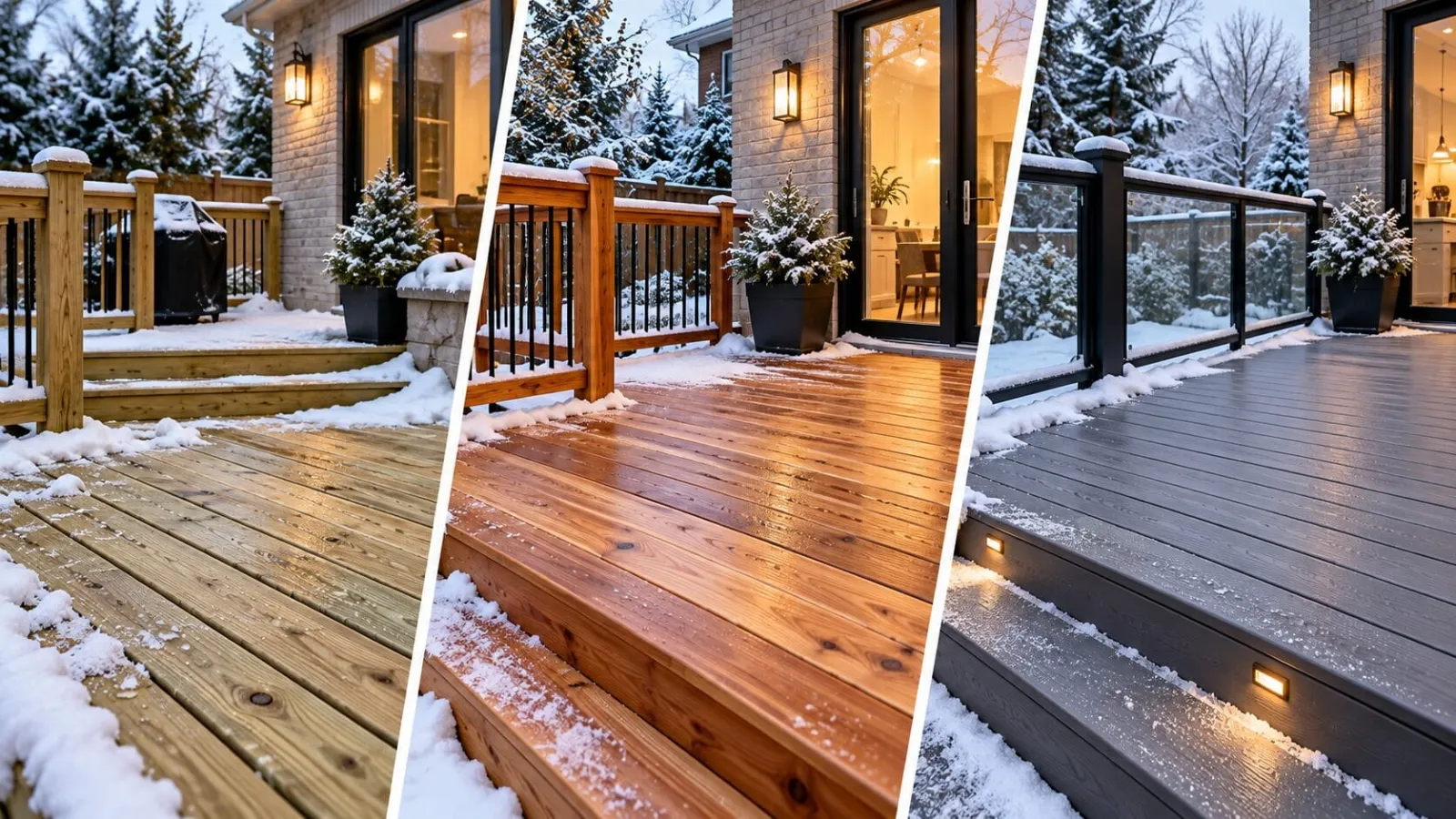
Pressure-treated wood remains the most common decking choice because it keeps upfront costs lowest, and with proper care it typically lasts around 15 to 20 years. Its main limitation in Ontario is movement and surface wear as it cycles through wet and dry conditions.
Cedar offers a warm natural appearance and better inherent decay resistance than treated pine, but it is a maintenance material above all. It needs regular sealing, and it is the softest of the three surfaces, so how you clear snow matters.
Composite is made from recycled wood fibre and polymer, and it resists rot, splinters and the staining cycle that wood needs. Its trade-offs are the higher purchase price, surface heat in direct sun and the need to follow the manufacturer’s installation requirements, which most warranties depend on.
3. Installed Costs in Toronto and the GTA
Installed deck prices vary widely, partly because quotes define “installed” differently (railings, stairs, height and demolition can all be in or out) and partly because site conditions and design differ from yard to yard. The ranges below show the spread of typical GTA pricing rather than a single price.
| Material | Lower end of typical GTA pricing (installed per sq ft) | Higher end of typical GTA pricing (installed per sq ft) |
| Pressure-treated | $25–$35 | $45–$65 |
| Cedar | $30–$45 | $55–$80 |
| Composite | $42–$75 | $65–$95 |
Other cost lines to budget for
- Labour. Labour typically makes up about 50–60% of total deck cost in the GTA.
- Railings. Typically $25–$100 per linear foot depending on material and style, and guards are required where a deck is more than 600 mm above grade.
- Permit. Toronto charges a deck permit fee that is adjusted annually. Confirm the current fee with Toronto Building.
- Stairs, lighting, skirting and demolition of an old deck. These are usually priced separately and can move a quote materially.
Twenty-year cost illustration
- Pressure-Treated Wood: An initial $7,000 deck plus approximately $300/year in staining upkeep totals approximately $13,000 over 20 years (excluding likely board replacement).
- Composite Decking: An initial $12,000 deck plus approximately $75/year in basic cleaning totals approximately $13,500 over 20 years.
- The Verdict: While composite costs significantly more upfront, the total 20-year cost of ownership is nearly identical to wood, while demanding far less manual labor.
4. What Matters More Than the Boards
A deck fails from the frame up. In Ontario winters, these elements decide how long any surface material lasts.
| Element | Why it matters in winter | What to ask your contractor |
| Footings | Shallow footings can heave in frost and shift the whole frame; footings generally go below the frost line, about 1.2 m (4 ft) in most of Ontario | Footing diameter, depth and whether the design suits the soil on site |
| Framing | Pressure-treated framing is the standard under every surface; composite should be matched to the manufacturer’s joist spacing | Joist size, spacing and species |
| House connection | Water at the ledger can rot the house framing as well as the deck | Ledger attachment and flashing details |
| Drainage and airflow | Trapped moisture shortens the life of wood framing and encourages mildew | Board gaps, ground clearance and how water drains away from the house |
| Fasteners and hardware | Moisture and de-icing salts accelerate corrosion | Corrosion-resistant fasteners and connectors suited to the material |
| Composite expansion gaps | Boards expand and contract with temperature | Gapping method and the manufacturer’s installation specification |
A mixed build is common and sensible: pressure-treated joists and posts under cedar or composite boards. Pairing composite boards with untreated or undersized framing can cause uneven movement and early problems.
5. Winter Care by Material
| Task | Pressure-treated | Cedar | Composite |
| Snow clearing | Use a plastic shovel; avoid digging into the surface | Plastic shovel or stiff broom; metal blades can gouge | Follow the manufacturer’s guidance; avoid metal blades |
| De-icing | Calcium chloride without colour dye, used sparingly and rinsed off later; no sand | Calcium chloride without colour dye, used sparingly; check finish compatibility; no sand | Calcium chloride without colour dye, rinsed off later (approved by Trex and Fiberon); no sand |
| Spring cleaning | Wash and inspect for cracks and loose fasteners | Wash, inspect soft spots where snow piled, reseal as needed | Wash off salt, dirt and organic debris |
| Re-finishing | Stain or seal every 1–2 years | Seal every 1–2 years | None required for the surface |
| Annual inspection | Posts, ledger, fasteners, railings | Posts, ledger, fasteners, soft spots | Posts, ledger, fasteners, railings |
No surface is slip-proof. Wet or icy boards of any material can be slippery, so clear snow promptly and use manufacturer-approved traction methods on stairs and walkways.
6. Toronto Permit and Code Checks Before You Build
The City of Toronto reviews building permits for a deck, veranda or porch built to an existing house, and notes that some detached decks may not need a permit. Applications are made through Toronto Building’s online portal and need details of footings, including size, spacing, depth and frost protection, along with stair construction and zoning information. In general, an attached deck or porch at any height, or a freestanding deck more than 600 mm above grade, should be expected to need a permit. Because rules can change and details vary by property, confirm the requirement with Toronto Building before starting.
Other items to check:
- Guards. Required where the walking surface is more than 600 mm (24 in.) above grade.
- Zoning and setbacks. Zoning bylaw compliance applies even when no building permit is required.
- Trees and conservation rules. Work near private or City trees, or in conservation areas, may need additional approvals.
- Other municipalities. Outside Toronto, permit triggers and fees differ across the GTA, so check with the relevant municipality.
7. How to Choose
- Choose pressure-treated wood if upfront cost is the main constraint, the layout is simple and you are willing to stain or seal it on a regular schedule.
- Choose cedar if you want a natural look and will commit to annual care, and you can accept that the soft surface needs careful snow clearing.
- Choose composite if you want to avoid refinishing, expect to keep the deck for 20 years or more and can afford the higher starting price.
- Consider a hybrid. Pressure-treated framing with cedar or composite boards is a common way to balance cost, structure and appearance.
- Whatever you choose, put the budget into footings, framing, flashing and fasteners first. A better board on a poor frame will not last.
Frequently Asked Questions
1. Which decking material is best for Ontario winters?
There is no single best material. Composite has the lowest upkeep and does not absorb moisture the way wood does, pressure-treated wood has the lowest upfront cost and cedar offers a natural look with higher maintenance. The right choice depends on your budget, how much upkeep you will do and how long you plan to keep the deck. Footings and framing matter as much as the boards.
2. How much does a deck cost in Toronto?
A pressure-treated deck typically costs $25–$65 per sq. ft., while a composite deck costs approximately $42–$95 per sq. ft., including installation. For a 12 × 12 ft. deck (144 sq. ft.), expect to pay around $5,500–$9,000 for pressure-treated wood or $9,000–$14,000 for composite decking in Toronto. Railings, stairs, deck height, demolition and permit fees can increase the total cost. Request an itemized quote to understand exactly what is included.
3. Is composite decking worth the extra cost in Ontario?
It can be if you plan to keep the deck long enough. Composite typically costs more upfront but avoids staining and sealing, and on typical GTA figures the 20-year totals for a 12 × 16 ft deck land within a few hundred dollars of pressure-treated wood. If you would be unlikely to maintain a wood deck on schedule, or you plan to sell within a few years, the comparison changes.
4. Can I shovel snow and use salt on a cedar or composite deck?
Use a plastic shovel or stiff broom rather than a metal blade, particularly on cedar, which is soft and can be gouged. For ice, use a calcium chloride ice melt without colour dye and rinse it off later; Trex and Fiberon approve this for their composite boards. Avoid sand, which scratches the surface. Rinse the deck in spring to remove salt and grime.
5. Do I need a building permit for a deck in Toronto?
A building permit is required for decks that meet Toronto’s permit requirements, including certain decks attached to a house. Some detached, low-level decks may be exempt. Decks more than 600 mm (approximately 24 inches) above grade require guards for fall protection.
Get Professional Advice on Your Deck Project
The best decking material for an Ontario winter is the one that suits your budget, your willingness to maintain it and a frame built to handle frost, moisture and snow. Comparing quotes on the full scope, including footings, framing, flashing, fasteners and permit work, gives a clearer picture than comparing board prices.
Jacko Contracting provides construction and renovation services for homeowners in Toronto and the GTA. If you are planning a new deck, replacing a worn one or deciding between wood and composite, an on-site assessment can help establish the right structure and material for your property.
Why Homeowners Choose Jacko Contracting
A deck is a long-term investment in your home’s outdoor living space. Choosing a contractor with clear protections, relevant experience and a commitment to workmanship helps homeowners make informed decisions about their projects.
At Jacko Contracting, homeowners across Toronto and the GTA can benefit from the following company credentials and service commitments:
- $2 Million Liability Insurance: Liability coverage designed to provide protection against covered claims associated with construction work.
- 5-Year Workmanship Warranty: A stated workmanship warranty that gives homeowners added reassurance about the quality of completed work. Ask about the applicable terms and exclusions for your specific project.
- WSIB Clearance Certificate: A published company credential that homeowners can request to review when assessing contractor compliance.
- Home Depot Pro Affiliation: Jacko Contracting identifies itself as a Home Depot Pro partner, supporting its professional approach to construction and renovation projects.
- 5-Star Google Reviews: The company’s contact page highlights its customer ratings. Homeowners can review customer feedback to learn about other clients’ experiences.
- 20+ Years of Experience: Jacko Contracting highlights more than 20 years of industry experience across its construction and renovation services.
- Free Estimates: Homeowners can discuss their deck project and request an estimate before deciding how to proceed.
For a deck that has to handle Ontario winters, the goal is not simply to pick a board. It is to match the material to your budget and upkeep habits, build the frame and footings correctly and secure the right approvals.
Planning a deck in Toronto or the GTA? Contact Jacko Contracting to discuss your project and request a free estimate.
Contact Jacko Contracting
Phone: 647-642-4664
Email: info@jackocontracting.com
Website: www.jackocontracting.com
Request a Free Estimate: https://jackocontracting.com/contact-us/
Explore our backyard deck building service, see the composite multi-level deck we built in East York, or browse all of our deck and outdoor services across Toronto and the GTA.