Executive Summary
Backyard drainage problems in Toronto are more than a landscaping nuisance. Repeated pooling, saturated soil, runoff toward a basement, or water collecting beside a patio can damage landscaping and contribute to moisture problems around the foundation.
The right solution depends on where the water is coming from and how it moves across the property. Some yards only need grading corrections, while others benefit from a French drain, catch basin, channel drain, downspout extension, or a combination of systems.
As a planning range, basic backyard drainage work in the GTA typically starts around $1,500–$4,500 for surface regrading. A yard French drain generally costs $3,500–$9,500, while a catch basin with underground piping can range from $2,200–$4,800+. Dry wells and infiltration systems typically start around $4,500, and complex multi-component drainage projects can cost $6,500–$18,500+.
These are planning estimates, not fixed quotes. Final pricing depends on excavation depth, soil conditions, drainage length, access, discharge method, and landscaping restoration. Extensive excavation or complicated drainage requirements can push a project above these ranges.
Toronto properties also have municipal requirements that affect how stormwater is handled. The City requires property owners to disconnect downspouts from the City sewer system, with runoff directed safely away from the foundation and without creating problems for neighbouring properties or public sidewalks.
For larger drainage projects, buried storm piping, catch basins, storm connections, foundation drainage and site servicing may involve permit or municipal review requirements. A site assessment should therefore come before choosing a drainage system so the contractor can identify the source of the water, confirm grades and recommend an appropriate construction method.
Quick Comparison: Toronto Backyard Drainage Solutions
| Solution | Typical GTA Planning Range | Best For | What It Does |
| Surface Regrading / Swales | $1,500–$4,500 | Minor pooling and poor surface flow | Changes finished grades so runoff moves toward a suitable drainage area |
| French Drain | $3,500–$9,500 | Persistently saturated soil or low areas | Collects subsurface water and conveys it to an appropriate outlet |
| Catch Basin with Underground Piping | $2,200–$4,800+ | Defined low points and concentrated surface runoff | Collects water and routes it through a drainage pipe |
| Channel Drain | $2,500–$6,000 | Patios, walkways and driveway edges | Captures surface water along hardscape areas |
| Dry Well / Infiltration System | $4,500–$9,000+ | Suitable properties with adequate infiltration | Temporarily stores and infiltrates runoff where site conditions permit |
| Multi-Component Drainage System | $6,500–$18,500+ | Properties with several drainage problems | Combines grading, drainage pipes, catch basins or other components |
Why Toronto Backyards Develop Drainage Problems?
Soil and Infiltration Conditions
Some Toronto and GTA properties have dense or clay-rich soils that can infiltrate water slowly. When heavy rain falls faster than the ground can absorb it, low areas can remain saturated and surface runoff can concentrate near foundations, patios and walkways.
Freeze-Thaw and Seasonal Rainfall
Toronto’s freeze-thaw cycles, spring snowmelt and intense summer storms can expose existing grading or drainage weaknesses. Water management should account for both seasonal runoff and winter conditions rather than relying on a single dry-weather inspection.
Infill Construction and Hardscaping
Larger building footprints, patios, walkways, driveways and other hard surfaces can change how water moves across a lot. A drainage solution should consider the entire runoff pattern, including downspouts and neighbouring grades where relevant.
Downspout Disconnection
Toronto requires property owners to disconnect downspouts from the City’s sewer system. After disconnection, runoff should flow away from the foundation and should not negatively affect a neighbour’s property or flow directly onto a City sidewalk. This makes proper grading and downspout drainage an important part of many backyard drainage projects.
Top Construction Options for Backyard Drainage in Toronto
1. French Drain Installation
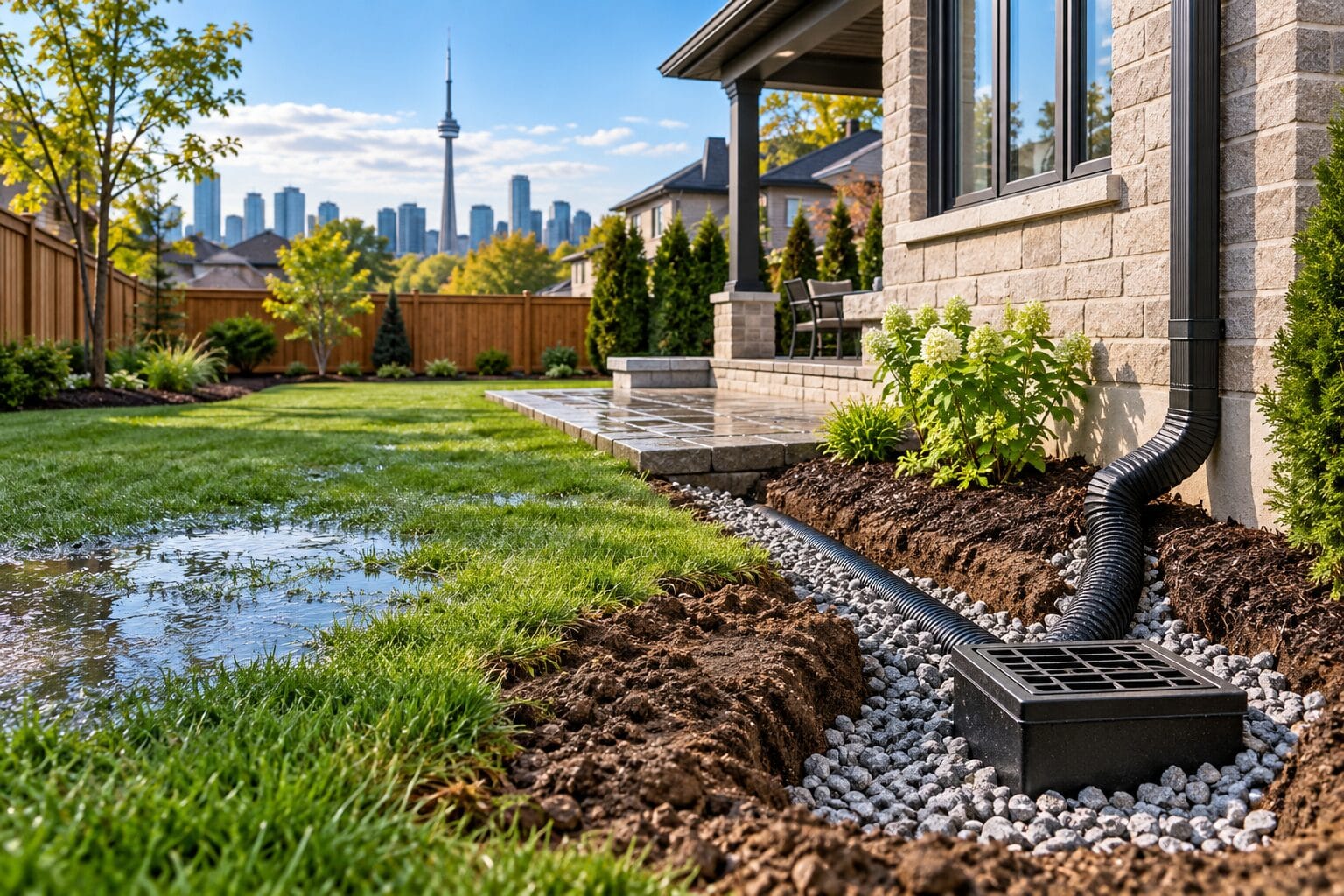
A French drain typically uses a gravel-filled trench, filter fabric and perforated drainage pipe to intercept water below the surface. It can be useful where soil remains saturated or where surface regrading alone cannot solve recurring wet areas. The exact pipe type, depth, outlet and stone/fabric assembly should be selected for the site rather than treated as a one-size-fits-all specification.
2. Catch Basins and Channel Drains
Catch basins are useful where runoff concentrates in a defined low point. Channel drains can be effective along patios, walkways and other hardscape edges. These systems need a properly planned outlet; installing a drain without solving where the collected water will go can simply move the problem.
3. Yard Regrading and Swales
Regrading changes the surface elevations to improve positive drainage. Swales can guide runoff through a landscaped area without requiring a fully underground system. Toronto’s published lot-grading guidance uses specific slope criteria for certain infill projects, so a contractor should verify the property’s existing grades and applicable requirements rather than applying one universal slope to every backyard.
4. Downspout Drainage and Runoff Management
A wet backyard may actually be receiving concentrated roof runoff. Depending on the property, the solution may involve relocating a downspout, extending discharge over a suitable permeable area, improving grading, or incorporating another drainage component. The goal is to move water away from the foundation without creating erosion, ponding or impacts on neighbouring properties.
How Do You Know Which Drainage System Your Backyard Needs?
| What You See | Likely Approach | Important Check |
| Water naturally flows toward the house | Regrading / surface drainage | Confirm finished elevations and where runoff can safely go |
| One defined low spot repeatedly fills | Catch basin or localized regrading | Confirm outlet and surrounding grades |
| Soil stays wet after the surface dries | French drain / subsurface drainage | Check groundwater, soil and existing foundation drainage |
| Roof runoff causes concentrated pooling | Downspout drainage / grading | Confirm downspout locations and safe discharge |
| Patio or walkway sends water toward lawn/house | Channel drain / regrading | Check hardscape slope and drainage outlet |
| Runoff enters from a higher part of the property | Swale / grading / interception | Assess the full drainage path and property boundaries |
| Several conditions occur together | Combination system | Diagnose the source before selecting components |
Don’t Install a French Drain Before Finding the Source of the Water
A French drain is not automatically the best answer to every wet-yard complaint. The actual cause may be a disconnected or poorly routed downspout, incorrect grading, a patio draining toward the house, a blocked outlet, a low window well, or a broader site drainage problem.
A good contractor should first trace the water path, review elevations and inspect existing drainage conditions before developing a design and planning approach. This helps prevent unnecessary excavation and reduces the risk of installing a system that does not address the underlying problem.
Backyard Drainage Cost in Toronto: What Affects the Price?
| Drainage Work | Planning Range | Main Cost Drivers |
| Basic surface regrading | $1,500–$4,500 | Yard size, minor grade corrections, soil movement and access |
| Heavy regrading with sod restoration | $2,500–$6,500 | Machine access, soil removal/import, extensive grade changes and landscaping |
| French drain | $65–$125 per linear foot | Length, depth, access, soil, pipe/stone assembly and restoration |
| Catch basin with underground piping | $2,200–$4,800+ | Number of basins, excavation, pipe run, outlet and surface restoration |
| Channel drain | $2,500–$6,000 | Drain length, grating, concrete or hardscape work and outlet |
| Dry well / infiltration excavation | $4,500–$9,000+ | Excavation depth, soil infiltration, system size, access and disposal |
| Multi-component drainage project | $6,500–$18,500+ | Combination of systems, excavation, discharge and restoration |
Planning ranges only: actual pricing varies by property. A site assessment is needed to confirm the drainage cause, grades, access, soil conditions, excavation requirements, discharge method and restoration scope.
Toronto Permits, Drainage Rules & Municipal Considerations
Downspout Disconnection
The City of Toronto states that all property owners must disconnect downspouts from the City’s sewer system. Disconnected water should flow away from the foundation and must not negatively affect neighbouring property or flow directly onto a City sidewalk.
Stormwater and Lot Grading
Toronto’s lot-grading guidance for applicable infill housing requires drainage to be designed so water does not accumulate at or near the building or adversely affect adjacent properties. It also addresses side-yard and swale slopes, catch basins on private property, and restrictions on directing storm drainage to a sanitary sewer.
When Municipal Review or a Permit May Be Relevant
Not every backyard drainage repair follows the same approval path. Depending on the scope, work involving buried storm piping, catch basins, drainage systems, site servicing, foundation drainage or a new/upsized storm connection can involve plumbing/drain permits or Toronto Water review. The City currently lists permits for buried storm piping and catch basins, and separate requirements can apply to storm connections and private-water discharge. Confirm the applicable requirements before excavation.
Utility Locates and Safe Excavation
Before excavation, underground utilities should be located and the work area planned for safe access. A professional contractor should also consider existing services, property boundaries, foundation conditions, trees and hardscape before digging.
How to Choose a Backyard Drainage Contractor in the GTA
- Site diagnosis: The contractor should explain where the water is coming from and why the proposed system addresses that cause.
- Grade verification: Laser or other accurate elevation equipment can help establish existing and proposed drainage paths.
- Appropriate materials: Ask what pipe, filter fabric, stone, catch basin and outlet system will be used and why it fits the site.
- Insurance and workplace coverage: Confirm appropriate commercial liability insurance and current WSIB status where applicable.
- Written scope and warranty: The proposal should clearly identify excavation, drainage components, restoration, exclusions and warranty terms.
Frequently Asked Questions
How much does backyard drainage cost in Toronto?
Basic surface regrading in the GTA typically costs $1,500–$4,500. Installing a yard French drain generally ranges from $3,500–$9,500, while a catch basin with underground piping costs approximately $2,200–$4,800+. Dry wells and infiltration systems typically cost $4,500–$9,000+, and complex multi-component drainage systems can range from $6,500–$18,500+. Extensive excavation, difficult access or restoration requirements can push costs above these ranges.
What is the best drainage solution for a wet backyard?
There is no single best system. Regrading works well for surface-flow problems, while French drains can help with persistent subsurface saturation. Catch basins, channel drains and downspout improvements may be better for concentrated runoff. Some properties need a combination. The best choice depends on the source of the water, site grades, soil conditions and available discharge options.
Do I need a French drain or yard regrading?
If your Toronto backyard suffers from minor surface pooling caused by poor grading, regrading ($1,500–$4,500) may be sufficient. If the soil remains persistently saturated below the surface, a French drain ($3,500–$9,500) may be appropriate to intercept and divert subsurface water.
Do I need a permit for backyard drainage in Toronto?
It depends on the scope. Certain buried storm piping, catch basins, plumbing/drain work, site servicing and storm connections can trigger permit or municipal review requirements. Confirm the applicable requirements for the property and proposed work before construction..
Can backyard drainage help prevent basement flooding?
Improving grading, downspout drainage and surface runoff can reduce water reaching the foundation. However, recurring basement flooding can have multiple causes, so exterior drainage should be evaluated alongside foundation waterproofing and other site conditions.
Can I redirect downspout water into my backyard?
Toronto permits downspout water to be redirected onto the property where it can drain safely. The City says the flow should move away from the foundation and should not negatively affect neighbouring property or flow directly onto a sidewalk. The appropriate discharge method depends on the property’s grading, soil and available drainage area.
Get Your Backyard Drainage Problem Assessed
Don’t choose a drainage system based on a wet spot alone. Jacko Contracting can assess grading, runoff patterns, existing drainage conditions and the practical construction options for your property.
The goal is to recommend the right level of work—from targeted grading improvements to a more complete drainage system—without adding unnecessary components.
| Contact | Details |
| Call | 647-642-4664 |
| Request a Free Estimate | https://jackocontracting.com/contact-us/ |
| info@jackocontracting.com | |
| Service Area | Toronto, North York, Scarborough, Etobicoke, Mississauga, Brampton, Vaughan, Richmond Hill, Markham and Oakville |
Why Homeowners Choose Jacko Contracting
- 15+ Years Experience — Water management, excavation and exterior construction experience across the GTA.
- Licensed & Insured — Appropriate insurance and WSIB coverage for qualifying work.
- Site-Specific Solutions — Drainage recommendations based on the property’s grades, runoff and existing conditions.
- Clear Scope of Work — Drainage components, excavation and restoration are defined before construction begins.